Telares de Palo Grande
I scaled a heritage brand into 6 global markets during an economic collapse, achieving 13% MoM growth by identifying a niche "gym towel" market wedge...

Telares de Palo Grande has been making textiles under their brand Ama de Casa in Venezuela for over a century. By 2015, when I joined as their e-commerce and brand specialist, the company had survived everything the country had thrown at it — political upheaval, currency controls, supply chain chaos. It was still standing. Still manufacturing.
What it hadn't done was figure out how to sell outside Venezuela.
That became my problem. And the context mattered: this wasn't a growth initiative. Venezuela's economy was deteriorating fast. Government controls were squeezing the local market from every direction — price regulations, currency restrictions, contracting consumer spending. The logical response was to look outward. We had a devalued currency and a century of manufacturing knowledge, which meant our production costs were genuinely competitive on a global scale.
Exporting should have been the obvious move. It wasn't. Strict government export regulations made it either impossible or unprofitable for most product categories. The conventional path was closed.
What I found, after digging into the regulations, was a gap. Small packages — the kind individual customers order online — fell outside the export controls that governed commercial shipments. That one detail changed everything. It meant that if we could build a direct-to-consumer e-commerce operation, we had a legal, workable route to international markets that the regulations hadn't anticipated.
That was the opening. The next question was how to compete once we got there — and that's where the real problem started.
The problem with competing on price
The first thing I understood when I started mapping the international market was that we couldn't win on price. Not a chance. Asian manufacturers had that market locked — lower cost, higher volume, and years of established presence on Amazon and MercadoLibre. If we positioned Ama de Casa as just another affordable towel, we'd lose before we started.
So the question became: what could we actually own?
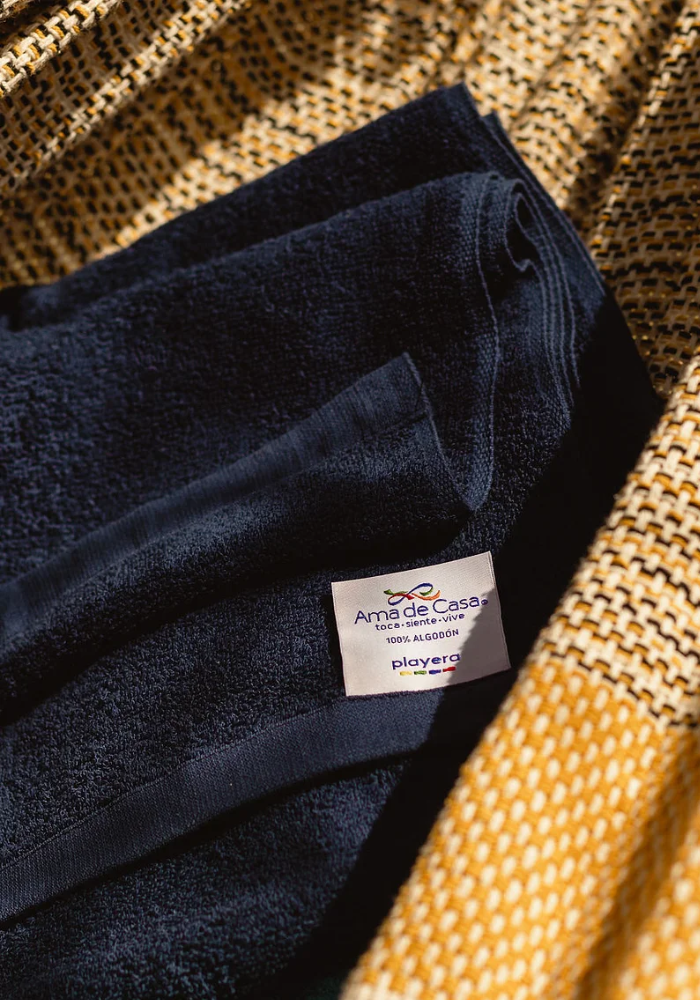
The answer was in the product itself, if you knew where to look. The cotton came from farms near the Orinoco River, in one of the most biodiverse regions on the planet. The manufacturing used no chemical or industrial softeners — which made the towels feel slightly rougher than competitors', but also gave them something most towels don't have: maximum absorption from day one, and no synthetic residue against your skin. It wasn't a compromise. It was a different set of priorities entirely.
I built the brand positioning around that. Natural. Health-conscious. Exotic but credible — because the origin story was real. Vibrant colors that reflected Venezuelan craft traditions, paired with a provenance narrative that cheap imports simply couldn't match.
Then I went looking for the niche.
The gym towel insight
You can't sell a full brand story to a new customer in a new market on the first transaction. You need an entry point — something specific enough to resonate, something that earns the second purchase.
I found it in the data. Tracking daily sales, comments, and customer emails across platforms, a pattern emerged: the intermedia size was performing. It sat between a bath towel and a hand towel — not quite either, but perfect for the gym. Compact enough to throw in a bag, absorbent enough to actually work, and natural enough to feel like something you'd choose rather than just grab.
That became the wedge. All our marketing efforts pointed at the health-conscious gym-goer as the entry customer. The pitch was simple: no chemicals, maximum absorption, made from cotton grown in the Amazon basin. Once they tried one, the upsell to a full set was a natural conversation. We weren't selling towels. We were selling a point of view about what you put on your body.
The operational problem nobody warned me about
Finding the regulatory gap was one thing. Actually building an operation inside it was another.
DHL and UPS still operated in Venezuela, and their rates were calculated at the official exchange rate, which bore almost no relationship to the real market rate at the time. That gap meant express international delivery cost us roughly three to four dollars per order. We baked it into the price. Customers in six countries — the US, Canada, Mexico, Colombia, Chile, and Peru — received their orders within five business days from Caracas. From Caracas.
The harder problem was profitability in a currency that was losing value faster than you could track it. I built a system that monitored the black market exchange rate and updated our prices across platforms every four to six hours. Not because I wanted to. Because if we didn't, we were selling at a loss before the day was over.
The partnership that made it possible
None of this would have existed without finding the right partner. Tradercom was a startup that had built a successful cross-border e-commerce platform called Traetelo.com — connecting goods from the US to LATAM customers, and doing it well. When I found them, they had the infrastructure, the logistics relationships, and a working model. What they didn't have was anyone running it in reverse. We were the first.
It was an almost frictionless alignment of incentives. They needed a real-world experiment. We needed a path to market without the capital to build one ourselves. The partnership cost us almost nothing and gave us infrastructure that would have taken years to build independently.
Within months, the new business unit was growing at 10% in monthly sales and 13% in monthly transactions. Considering we were operating from a country in economic freefall, shipping to six new markets simultaneously, on a budget that didn't exist — those numbers felt like something.
What it taught me
This was my second job out of university, after an internship at Procter & Gamble. I was young enough not to fully appreciate how abnormal the conditions were. Political instability, currency collapse, export restrictions, security concerns — all of it was just the environment. You adapted or you didn't ship.
What I learned, and carry forward, is that constraints don't just force creativity — they force clarity. When you can't compete on price, you find out very quickly what else you have. When you can't rely on stable logistics, you build systems. When you can't afford to get pricing wrong, you instrument everything.
The Orinoco River story, the gym towel niche, the four-hour price updates — none of those were clever ideas born in a comfortable office. They were the result of having no other options and paying very close attention to what the data was trying to tell me.
That's a way of working I've never stopped using.
Rafael J. Schwartz
Product leader. Writing about teams, clarity, and building things that matter.
More work

Let’s talk
If something here resonated, if you're working through a product problem, or if you just want to think out loud — reach out!